Clays And Clay Minerals In Natural And Synthetic Systems
Clays And Clay Minerals In Natural And Synthetic Systems
Volume 21 (Developments In Sedimentology)
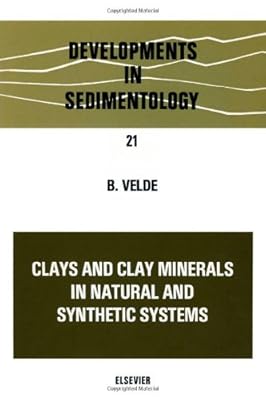
By B Velde, 1977
Download (7.76 MB)
* Publisher: Elsevier Science
* Number Of Pages: 226
* Publication Date: 1977-01-15
* ISBN-10 / ASIN: 044441505X
* ISBN-13 / EAN: 9780444415059
* Series: Developments in Sedimentology Series
Introduction:
The study of clay minerals and clay assemblages has been and still is, for that matter, greatly hampered by the innate character of a material which, by its definition, is of small particle size. Little things are at times easier to study than big ones as witnessed by the immense advances in nuclear physics. 1lowever.in the case of natural silicates this is not true. Since the material has a small grain size, different phases can be easily mixed mechanically, making it difficult to separate them physically one from the other and difficult to identify them optically since their diameter approaches the limit of common optical resolution. One is left with X-ray diffraction or techniques which deal with energy absorption by a crystalline structure as means of investigation. Since these methods have only recently become commonly available to geologists and mineralogists, much of the pertinent information on clay minerals is still relatively new. A parallel interest has developed in experimental silicate phase equilibria concerning phyllosilicates in recent years which has allowed development of systematics in mineral stability studies.
It should be possible, through a unification of chemical and mineral structure data and the results of experimental studies on silicate phase equilibria, to develop a general picture of clay mineralogy based upon the known chemical behavior of phyllosilicates under various physical conditions. The major elements for such a study are presently available in a rough outline. It is fact the purpose of this essay to summarize the available information and create a general outline of clay mineral petrology. It is hoped that such an attempt meets with some success and, more important in the long run, that such an attempt will interest others in similar exercises, especially those of precision and revision.
Contents:
Clays and Clays Minerals in Natural and Synthetic Systems
Cover
Title Page
Copyright Page
Contents
Chapter I. Introduction
1. Choice of Information
2. Chemical Coordinates for Clay Mineral Assemblages
3. Clay Mineral Names and Structures
4. Chemical Systems
5. Chemical Potential; Inert and Mobile Components
6. Stability and Meta-Stability
7. Sedimentation and Burial
Summary
Chapter II. Minerals and Mineral Groups
1. Silica
(a) Weathering
(b) Sedimentary Environment
(c) Sedimentary Rocks
(d) Hydrothermal Alterations
Summary
2. Kaolinite, Pyrophyllite, Gibbsite and Talc
(a) Chemiographic Character of Kaolinite and Gibbsite
(b) 2:l Structures
CONCLUSIONS
3. Potassic Micas and Mica-like Minerals
(a) Illite
(1) Polymorphs
(2) Synthesis of Phengites and "Illites"
a - Phengite
b - Illite
(3) Natural Illite Compositions
(b) Celadonites and Glauconites
(1) Synthesis
( 2 ) Sedimentary Glauconites (pelletal)
(3) Thermodynamic Description of the Formation of Sedimentary Glauconite Pellets
(c) Celadonites, Glauconites and Illites as a Compositional Series
(d) Phase Diagram for the Illite-Glauconite Mixed Layered Minerals
SUMMARY
4. Montmorillonites
(a) Montmorillonite Solid Solutions
(b) Montmorillonite Occurrences in Nature
(1) Weathering
(2) Sediments
(3) Sedimentary Rocks
(4) Hydrothermal Alteration
(5) Volcanic Rocks
(c) Trioctahedral Expanding Minerals
(1) Studies in synthetic systems
(2) Relative Stabilities of Synthetic Trioctahedral Montmorillonites
(3) Chemica1 Composition of Natural Trioctahedral Montmorillonites
(4) Experiments on Natural Vermiculites
(d) Dioctahedral Montmorillonites
(1) Synthetic Dioctahedral Montmorillonites
(2) Experiments on Natural Dioctahedral Montmorillonites and Mixed Layered Minerals
(e) Summary of the Information from Experimental Studies
(f) Chemical Composition of Natural Fully Expandable and Interlayered Dioctahedral Minerals
(g) Phase Diagrams for Dioctahedral Montmorillonites (Chemical Components Inert)
SUMMARY
5. Illite, Montmorillonite and Mixed Layered Minerals in Sequences of Buried Rocks (P-T Space)
SUMMARY
6. Chlorites
(a) Natural Occurrences
(1) Weathering
(2) Sedimentation
(3) Sedimentary 7 Chlorites
(4) Sedimentary Rocks
(b) Experimental Studies on Magnesian Chlorites
(c) Chlorite Chemistry and Iron-magnesium Distribution among Phyllosilicates
(d) Composition of Some Natural Chlorites Formed in Various Physical Environments in Pelitic Clay Mineral.Suites.
SUMMARY
7. Corrensite
8. Zeolites
(a) Natural Occurrences
(1) Weathering
(2) Sedimentation (Continental, Shallow Marine)
(3) Deep Sea Sediments
(4) Sedimentary Rocks
(5) Summary of Natural Occurrences
(b) Zeolite Synthesis and Stability
(c) Chemiographic Analysis
(1) Zeolite Compositions
(2) Phase Diagrams for Zeolite--Clay Mineral Systems (Systems with Fixed Chemical Components)
(d) Systems with Variable Chemical Activities
CONCLUSIONS
9. Sepiolite-Palygorskite
(a) Chemical Composition
(b) Experimental Studies (solution equilibria)
(c) Phase Diagrams (closed system)
(d) Sepiolite-Palygorskite Equilibria in Saline Lakes and Basins
(e) Weathering Profiles
(f) Deep Sea Cores
10. Organic Material in Sedimentary Rock Sequences
Summary
Chapter III. General Phase Diagrams for Aluminous Clay Mineral Assemblages
1. Introduction
2. Surface Conditions
(a) Composition Diagram
(b) Composition-Activity Diagram
(c) Activity-Activity Diagrams
3. Temperature-Composition Diagrams
(a) The Mica-montmorillonite Cycle in Weathering and Diagenesis
4. Phase Relations in Pelitic Rocks; Composition Diagrams
5. Hydrothermal Alteration
6. General Statements
(a) Weathering
(b) Sedimentation
(c) Shallow Burial
(d) Metamorphism and Diagenesis: P-T Space
(e) Cation Exchange
7. Conclusion
References
Index
 با گسترش روزافزون و اهميت بيش از پيش رسانههاي ديجيتال در دنياي معاصر؛ بهرهگيري از اين ابزارها جهت تسريع در رشد علمي كشور ناگزير است. از اين رو هدف از راهاندازي اين وبلاگ ايجاد فضايي جهت بحث و تبادل نظر در خصوص رشتهي زمين شناسي به صورت عام و گرايش چينه و فسيل شناسي به صورت خاص و ارائهي كتب و مقالات مرتبط با اين شاخه از علوم است.