Late Neogene (نئوژن پسین)
نئوژن پسین
Late Neogene
(Developments in palaeontology and stratigraphy)
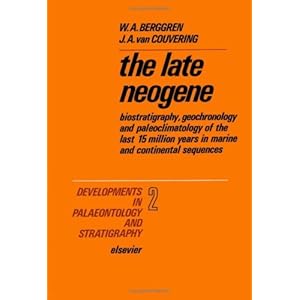
By W.A. Berggren, John A.Van Couvering, 1974
Download... (3.45 MB)
Mirror 2 (embedupload.com)
(Rapidshare, Megaupload, Hotfile, 2shared, Filefactory, Depositfiles, 4shared)
* Publisher: Elsevier (November 1974)
* Number Of Pages: 228
* ISBN-10 / ASIN: 0444412468
* ISBN-13 / EAN: 9780444412461
FOREWORD
The attainment of ever more precise correlation is the main goal of stratigraphical geology. Subdivision of geological time, as represented in the sedimentary rock record, has occupied the talents and tested the ingenuity of geologists for over two centuries, if we take the work of William Smith as the first significant contribution in this respect. The ability to recognize and distinguish smaller and smaller units of time by biostratigraphical methods is a tribute to an increased understanding of evolutionary patterns, improved instrumentation, and a growing body of informative, descriptive and interpretative literature. of a more refined zonation of Cenozoic marine biostratigraphy using the planktonic Foraminifera. This work, origiiially begun in the Soviet Union in the 1930’s, was later expanded to the Caribbean region, primarily by oil company paleontologists. The information obtained by specialists in various regions lay fallow for many years, but with the recent increase in communication between specialists in all parts of the world, we have seen in the past ten years greater advances in intercontinental zonation and correlation of the Cenozoic biostratigraphy of planktonic Foraminifera than in the preceding thirty. These more recent advances have gone foreward at the same time with the formulation of zonation schemes based on calcareous nannoplankton, radiolarians and diatoms, three other groups of microplankton which are increasingly useful in regional biostratigraphic correlation. More or less simultaneously, studies of “micro-”mammals in the Cenozoic of Europe have brought about remarkable advances in continental biostratigraphy. Recent advances in geophysics have also had a strong influence on paleontology. Paleomagnetism has aided in the reconstruction of past paleogeographies (and attendant paleolatitudes) and thus provided a framework for the interpretation of distribution patterns of fossil life forms as well as understanding past climatic history of the earth. Of particular importance has been the influence of the Late Neogene paleomagnetic polarity reversal time-scale whereby biostratigraphic horizons and/or zones can be calibrated to the ordinal time-scale with a high degree of accuracy. Furthermore, the Neogene approximates that part of geological history in which the biological record itself can be calibrated by radiometric dates having a confidence interval less than the life span of an average species (0.1-1.0 m.y.). Such calibrations appear to justify the use of biochronological “datum” events - changes in the fossil record with extraordinary geographical limits - in correlating both land mammal and marine microplanktonic successions in different species assemblage contexts, and in evaluating the synchroneity of successions which have evolved in parallel with occasional exchanges.
 با گسترش روزافزون و اهميت بيش از پيش رسانههاي ديجيتال در دنياي معاصر؛ بهرهگيري از اين ابزارها جهت تسريع در رشد علمي كشور ناگزير است. از اين رو هدف از راهاندازي اين وبلاگ ايجاد فضايي جهت بحث و تبادل نظر در خصوص رشتهي زمين شناسي به صورت عام و گرايش چينه و فسيل شناسي به صورت خاص و ارائهي كتب و مقالات مرتبط با اين شاخه از علوم است.